Back to creation logs

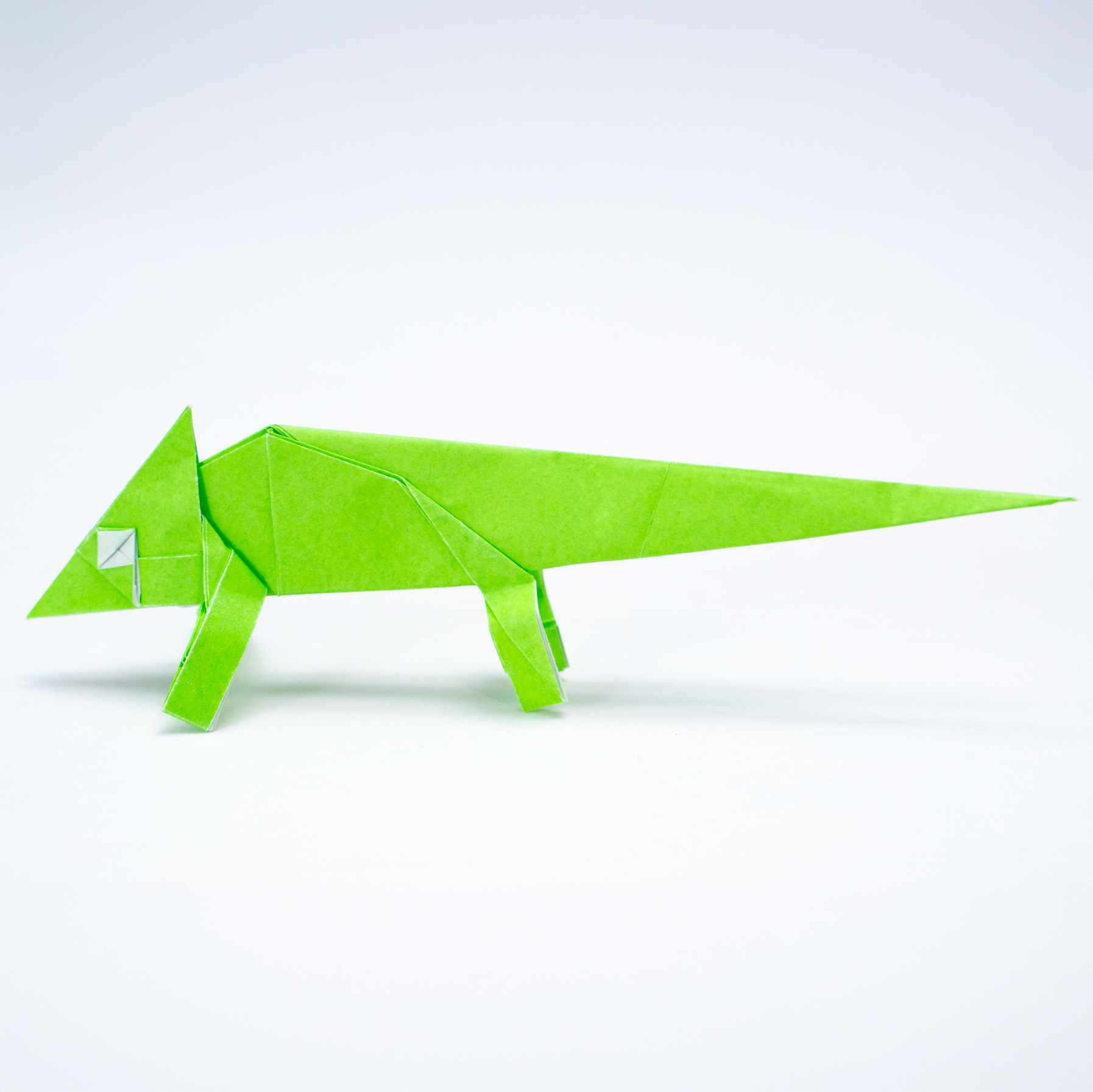
Chameleon

1Design note

First, I deepen my understanding of the chameleon’s shape and body structure by looking up images from various angles and watching videos of it moving. (For animals, I recommend slow-motion videos posted by National Geographic on platforms like TikTok.) After that, I make sketches and work out the rough proportions of each body part.

Logged at: Apr 11, 2026, 05:36 AM

2Prototype

Next, to determine the basic structure, I try making a range of structures that can fold out a chameleon-like form—its distinctive head with prominent eyes, a long tail, and four legs. From those, I choose the structure that’s closest to the chameleon’s proportions (this time, the one in the second row from the top). The deciding factor was that it allows the tail to be folded out long. (This is a tentative choice, so it may be revised later.)

Logged at: Apr 11, 2026, 05:37 AM

3Prototype

Try folding it in to some extent. It seems I’ll need to move the hind legs a bit farther back and increase the amount of paper allocated to the head section.

Logged at: Apr 11, 2026, 06:04 AM

4Prototype

I tried adding an extra ┌-shaped area on the head side so I could form the head shape and fold out the eyes, and it started to look more convincing. From here, I’ll refine the details while adjusting the proportions, focusing on giving the head and body more three-dimensional form.

Logged at: Apr 11, 2026, 06:32 AM

5Design note

The ratio between A and B corresponds to the proportions of the head versus the limbs, and I want to make the limbs as long as possible (i.e., make B larger). However, due to structural constraints in pattern a, there’s an upper limit to how long the corners can be. So if B is too large, the balance between the front and hind legs breaks down. For that reason, I’ll do test folds with various A:B ratios to find the optimal proportion.

Logged at: Apr 11, 2026, 06:33 AM

6Prototype

When A:B is 1:1 (same as the prototype in ❺)

Logged at: Apr 11, 2026, 07:03 AM

7Prototype

For a 1:√2 ratio

Logged at: Apr 11, 2026, 08:04 AM

8Prototype

In the 1:2 case (changing structure a from the crane base to the fish base), the balance between the head and the limbs seems best at 1:2. If I go to 1:3, the front legs become too short, so the optimal ratio is probably somewhere between 1:2 and 1:3. However, in terms of ease of folding, 1:2 might be the most stable choice.

Logged at: Apr 11, 2026, 08:04 AM

9Prototype

Keeping A:B at 1:2, I try adding an additional ┌-shaped extra area on the head side. (First, I crease a 9×9 grid, leave a one-cell margin in the top-left corner, and then use the remaining 8×8 area to fold the same way as before.) This allocates enough paper area to the head, but the limbs end up looking shorter. Also, the limbs develop too many pleats and become too thick to finish cleanly, so the extra area feels like it’s too much.

Logged at: Apr 11, 2026, 10:07 AM

10Design note

As I continued prototyping, I realized that the proportion of the C section (the head size) can also be adjusted. In other words, I need to choose the best combination of A:B:C ratios. When the head (C) becomes smaller, there’s less overlap between the head and the front legs, so the front legs become relatively longer. The hind legs can also be adjusted to some extent, which makes it possible to lengthen the legs overall. Based on my tests so far, 1:2:3/4 seems like a well-balanced ratio.

Logged at: Apr 11, 2026, 10:30 AM

11Prototype

A version with the A:B:C ratio set to 1:2:3/4

Logged at: Apr 11, 2026, 10:59 AM

12Prototype

Exploring finishing methods

Logged at: Apr 11, 2026, 02:06 PM

13Prototype

I decided to create two versions—a simple version and a detailed version—and settled on A:B:C = 1:1:2 for the simple version.

Logged at: Apr 12, 2026, 09:07 AM